
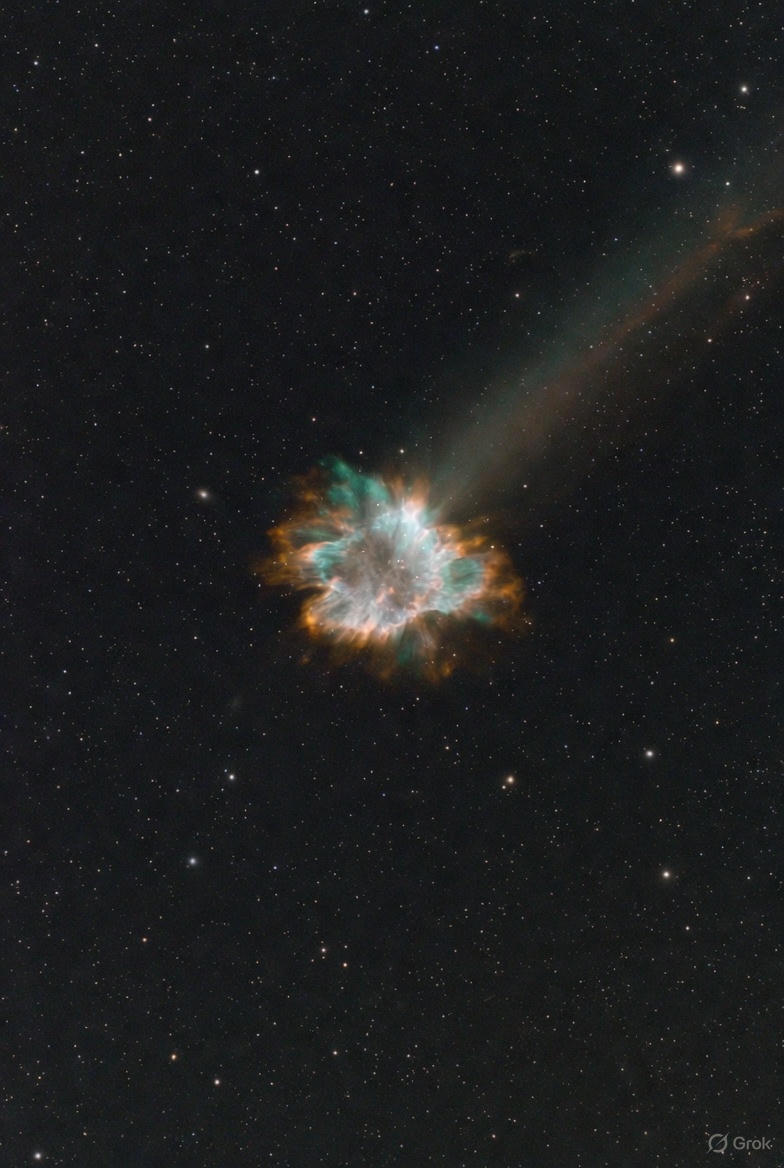
A rare interstellar visitor is making its way through our solar system, offering scientists a unique glimpse into materials from another star system. Interstellar comet 3I/ATLAS, only the third confirmed interstellar object ever detected, has been generating heightened activity as it passes through the inner solar system. According to NASA, the comet will safely make its closest approach to Earth on December 19, 2025, at a distance of approximately 170 million miles (1.8 AU), keeping it well outside any danger to our planet.
NASA’s Latest Observations of 3I/ATLAS
NASA’s newest imagery captures 3I/ATLAS in impressive detail. The Hubble Space Telescope reobserved the comet on November 30, revealing a compact nucleus surrounded by a diffuse coma and faint tail features. Observations from heliophysics missions also provided wide-field perspectives, illustrating how the comet’s dust and gas interact with the solar wind as it travels toward and away from the Sun.
Scientists note that the comet’s activity has increased since its perihelion (closest approach to the Sun) on October 30. Sublimating ices are driving jets that feed both the coma and tail, and variations in brightness hint at the comet’s rotation and the distribution of active vents on its surface. This activity gives astronomers valuable insight into the physics of interstellar comets, which may have compositions unlike anything in our solar system.
Key Dates and Distances for 3I/ATLAS
| Milestone | Date (2025) | Notes |
|---|---|---|
| Discovery | July 1 | Identified by the ATLAS survey as an interstellar object |
| Perihelion | Oct. 30 | Closest to Sun at ~1.4 AU |
| Closest to Earth | Dec. 19 | About 170 million miles away; no risk |
| Observation Campaign | Nov.–Dec | Coordinated multiwavelength monitoring |
Despite its proximity, 3I/ATLAS remains far beyond the Moon’s orbit and well outside Earth’s immediate neighborhood, making this flyby scientifically valuable but completely safe.
Viewing 3I/ATLAS from Earth
For casual observers, the comet will not be visible to the naked eye. Current estimates place it at magnitude 11–12, meaning it can be observed using moderate amateur telescopes under dark skies. Its rapid velocity—tens of miles per second—appears slow visually due to the large distance, but long-exposure imaging is necessary to resolve the comet’s tail structure.
Why 3I/ATLAS Matters
Interstellar objects like 3I/ATLAS are cosmic time capsules, containing materials formed in other planetary systems. By studying the comet, scientists can:
- Compare its ices, dust, and organic compounds to those of solar-system comets.
- Examine how jets and tail formation operate in interstellar comets.
- Analyze rotational patterns and nucleus shape from periodic brightness changes.
NASA’s coordinated campaign leverages multiple spacecraft, including deep-space asteroid missions, solar observatories, and high-resolution optical instruments. This multi-scale approach is producing an unprecedented dataset covering ultraviolet to radio wavelengths.
Safety and Ongoing Research
Contrary to sensational claims, 3I/ATLAS poses no threat to Earth. Its eruptions are standard cometary activity caused by sublimating ices, not explosions. As the comet moves past its closest approach on December 19, astronomers will continue analyzing new imagery and spectra, providing insights into the composition and dynamics of material from other star systems.
Quick Facts About 3I/ATLAS
- Type: Interstellar comet on a hyperbolic trajectory
- Closest to Sun: Oct. 30, 2025 (~1.4 AU)
- Closest to Earth: Dec. 19, 2025 (~1.8 AU / ~170 million miles)
- Visibility: Telescope only; not naked-eye
- Status: Active, scientifically valuable, and entirely safe
NASA’s ongoing observations of 3I/ATLAS are turning this fleeting visit into a lasting scientific opportunity, helping researchers explore the chemistry, activity, and structure of a comet from beyond our solar system.
